Heat pump
Hoover H-DRY 350 heat pump, 9kg
A 9kg heat pump dryer for a household that dries most weeks
4.5 on Amazon · 45 ratings · recorded 28 Oct 2026
£419See on Amazon Ad
Why this pick

Prices as of · details
A heat pump dryer if you tumble dry most weeks: Hoover's own 9kg pair shows 1.59kWh a full load against 5.18kWh for the condenser. A condenser if you dry now and then, want shorter cycles or pay less upfront. Neither needs a hole in the wall.
Heat pump
A 9kg heat pump dryer for a household that dries most weeks
4.5 on Amazon · 45 ratings · recorded 28 Oct 2026
Condenser
A 9kg condenser dryer for occasional, quicker drying
4.4 on Amazon · 79 ratings · recorded 28 Oct 2026
Smaller heat pump
An 8kg heat pump dryer for a shallower space
4.5 on Amazon · 185 ratings · recorded 27 Sept 2026
| Heat pump | Condenser | |
|---|---|---|
| Energy per full load | 1.59kWh on Hoover's 9kg H-DRY 350; 2.16kWh is typical, Hoover's guide says | 5.18kWh on the matching Hoover; 5.2kWh is typical, Hoover's guide says |
| Energy a year, label figure | 194kWh on the Hoover, over 160 drying cycles | 616kWh on the Hoover, over 160 drying cycles |
| Energy class | A+++ on the Hoover; A+++ to A+ is typical, Hoover says | B on the Hoover; B to C is typical, Hoover says |
| Drying time | Longer: about 197 to 209 minutes for 8kg of cotton, Beko says | Shorter: about 142 minutes for 8kg of cotton, Beko says |
| Where the water goes | A tank in the door on the Hoover; condensation class A, so more than 90% of the moisture is collected | A tank in the door on the Hoover; condensation class C, so more than 70% and up to 80% is collected |
| Vent or hole in the wall | Not needed, Electrical Safety First says | Not needed, Electrical Safety First says |
| Size and weight | 85 x 59.6 x 60.4cm on the Hoover; 43.2kg, Hoover says, 41.2kg on the listing | The same size on the Hoover; 32.5kg |
| Noise | 64 dB(A) on the Hoover | 68 dB(A) on the Hoover |
| Price to buy | Higher, Hoover and Beko say | Lower, Hoover says |
Buy a heat pump dryer if you use a dryer often and will keep it for years. Buy a condenser if you dry only occasionally, want faster drying or a lower purchase price. Hoover, which makes both, draws the same line: it suits the heat pump to households that dry frequently and plan to keep the appliance for many years, and says the condenser's lower price might make more sense for occasional use.
To keep the comparison fair, the picks below are Hoover's own pair: the H-DRY 350 in both versions, with the same 9kg drum, the same 85 x 59.6 x 60.4cm body and, on Hoover's site, the same 1 year labour and 10 years parts cover. What changes is how each one dries, and with it the energy, the time, the weight and the noise.
UK searchers are weighing the same pair: 'heat pump vs condenser tumble dryer' is one of the rising searches related to 'condenser tumble dryer' over the past five years, and both dryer types draw most interest from October to December (Google Trends, United Kingdom, checked 28 October 2026). If you are still deciding whether to buy a dryer at all, see heated airer or tumble dryer.
The difference is how each one heats the air. A condenser dryer heats air with an ordinary element, passes it through the clothes and then cools it, so the water condenses into a removable container, Hoover explains; it makes new heat for every cycle. A heat pump dryer recycles warm air in a closed loop: the damp air passes an evaporator that takes the moisture out, then is reheated and sent back through the drum.
So a heat pump dryer is a kind of condenser dryer. The 2026 tumble dryer regulations for Great Britain define a condenser tumble dryer as one with a system that removes moisture from the air used for drying, by condensation or any other means, and Hoover gives both of its dryers a condensation efficiency class. The practical differences are energy and time.
Yes, per load. Hoover's spec sheets give 1.59kWh for a full load in the heat pump H-DRY 350 and 5.18kWh in the condenser: under a third of the energy for the same 9kg of washing. The yearly label figures, worked out over 160 drying cycles of full and part loads, are 194kWh and 616kWh.
Hoover's running-cost guide (October 2024) gives typical figures of 2.16kWh for a full heat pump load and 5.2kWh for a condenser, and puts the heat pump cycle at less than half the cost. Beko says heat pump dryers can use up to 50% less electricity than vented or condenser models. For the cost of one load in your home, multiply the kWh by the unit rate on your bill.
That saving has to pay back a higher price to buy. Hoover and Beko both say a heat pump costs more upfront and that lower running costs can make up for it over time, so the number of loads you dry decides it. The catch is time.
A condenser. Beko gives about 142 minutes for a cotton eco cycle in an 8kg condenser dryer, against about 209 minutes for an A+ heat pump and 197 for an A++ one. Beko explains why: a heat pump works at lower temperatures, which takes longer but is gentler on clothes.
Owners notice it. Of the 8 reviews we read for the Hisense 8kg heat pump, 2 say drying takes longer than they were used to with older dryers. Beko calls the longer cycles a drawback for large families with a lot of laundry, and suggests planning the wash around them. Both send the water to the same place.
No. Electrical Safety First says neither a condenser nor a heat pump dryer needs a hole in the wall, unlike a vented dryer, whose extractor tube it recommends a professional to fit. Both keep the water from your washing in a container instead: on both Hoovers it is a tank in the door, and Hoover says you will need to empty it regularly unless the dryer can be connected to a drain.
How much of the water reaches that tank differs. Hoover's spec sheets give the heat pump condensation efficiency class A and the condenser class C. On the energy label scale for tumble dryers, class A means more than 90% of the moisture taken out of the load is condensed and collected; class C means more than 70% and up to 80%.
The door tank is what condenser buyers mention most: of 8 reviews we read for the Hoover condenser, in white and grey, 4 like that the water tank sits in the door and is simple to empty.
For a household that dries often, yes: they use far less energy and treat clothes more gently, in exchange for longer cycles and a higher price. Hoover and Beko both say the lower drying temperature suits delicate clothes, and Beko names wool and silk. Beko adds two habits: check each garment's care label first, and clean the filters and the evaporator regularly, as the manual explains.
Of the 8 reviews we read for the Hisense 8kg heat pump, 6 find it quiet and 4 say it uses little electricity for a tumble dryer; of 8 for the Hoover heat pump, 3 say it dries their washing well. On paper the Hoover heat pump is quieter than its condenser twin, 64 dB(A) against 68, but heavier, 43.2kg against 32.5kg, and Beko lists weight among the drawbacks of heat pump dryers. Whichever type you choose, the same safety rules apply.
Electrical Safety First says tumble dryers are involved in many UK household fires, so its advice covers both types. Stand the dryer by an external wall or window if you can, not in an enclosed space such as a cupboard; plug it straight into a wall socket, never an extension lead; and register it with the maker so you hear about any recall.
It also advises against running a dryer overnight where you can avoid it, says to clean lint and fluff from the filter and around the door after every use, and to take large, bulky items such as duvets to a dry-cleaner. It recommends buying from a reputable retailer rather than a third-party seller: every dryer below is an established brand sold by Amazon itself.
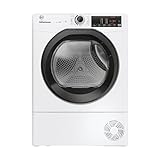
Hoover H-DRY 350 heat pump, 9kg
4.5 on Amazon · 45 ratings · 100+ bought last month · #4 in Heat Pump Dryers · recorded 28 Oct 2026
For frequent drying. Hoover's spec sheet gives this 9kg dryer energy class A+++, 1.59kWh for a full load, 64 dB(A) and a water tank in the door with a full-tank indicator. The listing says its sensor stops the cycle at the dryness you choose, from ready to iron to extra dry, and that the hOn app adds cycles over Wi-Fi.
Buyers like
Our summary of the 8 reviews Amazon showed on 28 Oct 2026, counted by us.
From the Amazon listing, recorded 28 Oct 2026. Sizes are the listing's own.
Price: we have checked it on 12 days; Amazon showed no discount of 10% or more on any of them.

Hoover H-DRY 350 condenser, 9kg
4.4 on Amazon · 79 ratings · 100+ bought last month · #1 in Condenser Dryers · recorded 28 Oct 2026
Limited time deal
For drying now and then, or when cycles must be short. It is the heat pump pick's twin, with the same 9kg drum, body and door tank. Hoover's spec sheet gives energy class B, 5.18kWh for a full load, condensation class C and 68 dB(A), and at 32.5kg it is lighter to move. The listing adds an Auto Care programme that adjusts to the load.
Buyers like
Our summary of the 8 reviews Amazon showed on 28 Oct 2026, counted by us.
From the Amazon listing, recorded 28 Oct 2026. Sizes are the listing's own.
Price: we have checked it on 12 days; Amazon showed a discount of 10% or more on 1 of them, including today.

4.5 on Amazon · 185 ratings · 400+ bought last month · #1 in Heat Pump Dryers · recorded 27 Sept 2026
For a heat pump in a tighter spot. The listing gives 8kg, 84.5cm high, 59.5cm wide and 55cm deep, against 60.4cm deep for the Hoovers, with a delay timer and 2 years of manufacturer cover. Electrical Safety First says a heat pump dryer needs no hole in the wall and is more energy-efficient than condenser and vented dryers.
Buyers like
Watch out for
Our summary of the 8 reviews Amazon showed on 27 Sept 2026, counted by us.
From the Amazon listing, recorded 27 Sept 2026. Sizes are the listing's own.
Price: we have checked it on 43 days; Amazon showed a discount of 10% or more on 4 of them.
Also recommended on: Heated airer or tumble dryer?.
Sources: Hoover: choosing the right tumble dryer, heat pump vs condenser vs vented; Hoover: how much does it cost to use the tumble dryer? (3 October 2024); Hoover: H-DRY 350 heat pump HRE H9A3TBE-80/N, technical specifications; Hoover: H-DRY 350 condenser HRE C9TBE-80, technical specifications; Beko: heat pump tumble dryers, efficiency, pros and cons; Electrical Safety First: tumble dryers usage and safety; legislation.gov.uk: Regulation (EU) No 392/2012, Annex VI, energy and condensation efficiency classes for tumble driers; legislation.gov.uk: Regulation (EU) No 392/2012, Annex VII, annual energy consumption and condensation efficiency; legislation.gov.uk: The Ecodesign for Energy-Related Products and Energy Information (Household Tumble Dryers) Regulations 2026; Google Trends: heat pump tumble dryer, condenser tumble dryer, vented tumble dryer, heat pump dryer, heated airer (United Kingdom, October 2021 to October 2026).